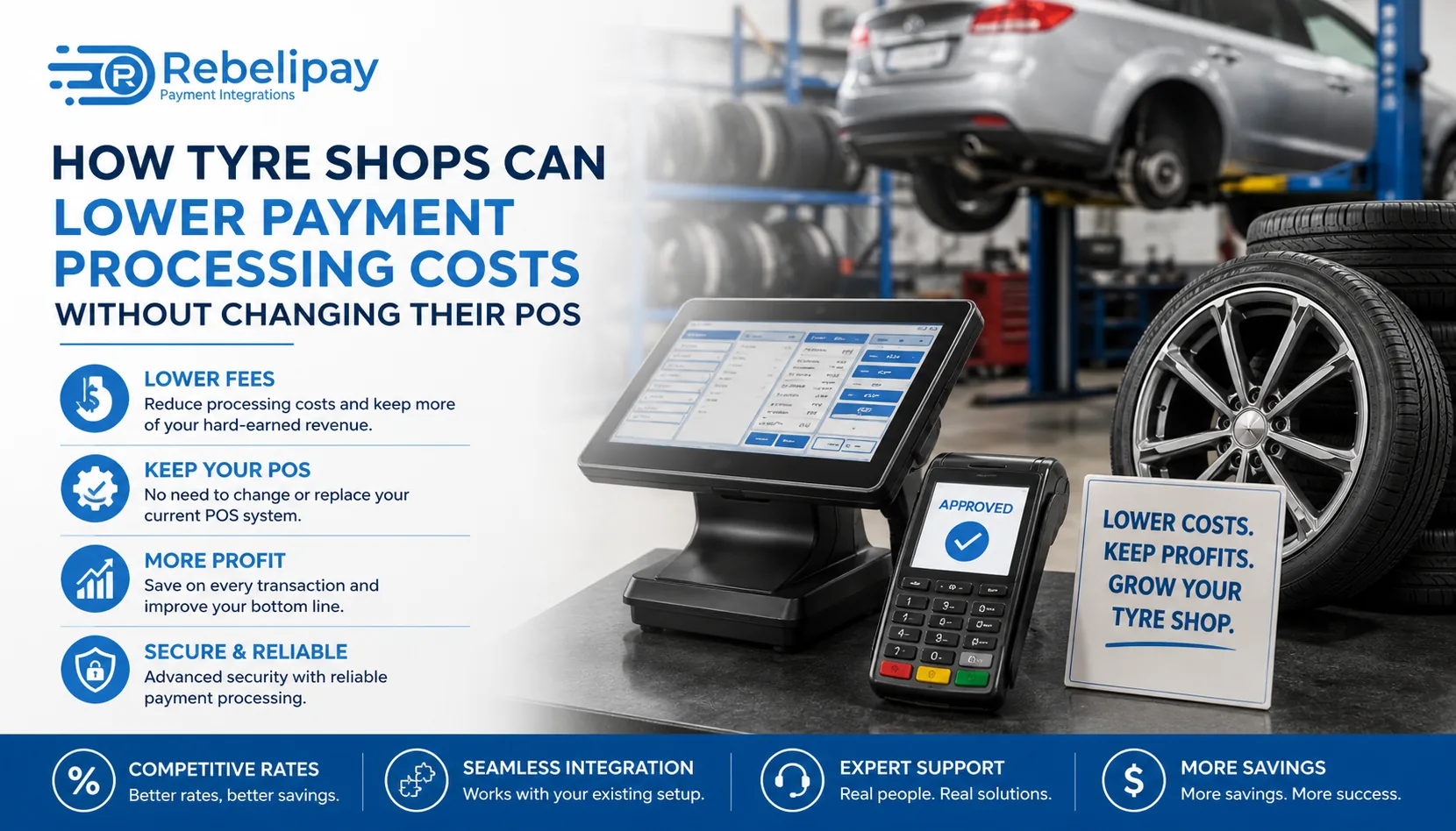
How Tyre Shops Can Lower Payment Processing Costs Without Changing Their POS
Running a tyre shop involves more than selling tyres. From tyre replacement and wheel upgrades to balancing, alignment, installation, and other automotive services, every transaction contributes to the overall profitability of the business.
For many tyre shops, card payments are a major part of daily sales. While accepting credit and debit cards makes checkout easier for customers, the cost of processing those transactions can quietly reduce margins.
When card volume increases, even a small difference in payment processing costs can have a meaningful impact on monthly revenue.
The right payment strategy can help tyre shop owners better understand these expenses, improve payment efficiency, and potentially keep more of the money they earn.
Payment Processing Can Have a Bigger Impact on Tyre Shops
A tyre purchase can be a relatively high-value transaction. A customer buying a full set of tyres may also add installation, balancing, alignment, warranties, or other services to the order.
This means a tyre shop can process substantial card volume throughout the month.
For example, a shop processing $60,000 in card payments every month needs to pay close attention to how much of that revenue is going toward payment processing.
The important question isn't simply:
"What is my processing rate?"
It is:
"How much am I actually paying to accept card payments?"
Understanding the difference can help tyre shop owners make better decisions about their merchant services.
Look Beyond the Rate on Your Merchant Account
Payment processing costs are rarely limited to one percentage.
Depending on your provider and pricing arrangement, your monthly expenses may include:
- Interchange costs
- Card network fees
- Processor markup
- Per-transaction charges
- Monthly account fees
- Payment terminal fees
- Gateway fees
- Other service charges
Two processors can advertise similar rates while producing very different total costs.
That's why tyre shops should evaluate their overall payment processing expense, rather than choosing a provider based solely on a headline rate.
Know Your Effective Processing Cost
One of the simplest ways to understand your payment expenses is to calculate your effective processing rate.
Suppose your tyre shop processes $60,000 in card transactions during one month and pays $1,500 in total processing-related costs.
The calculation would be:
$1,500 ÷ $60,000 = 2.5%
That 2.5% gives you a more realistic view of what you're paying to process payments.
Tracking this number over several months can help you identify changes in your costs and determine whether your current payment processing arrangement remains competitive.
Examine Your Merchant Statements
Your merchant statement can tell you a lot about how your payment processing costs are structured.
Instead of filing the statement away each month, take some time to review it.
Pay attention to:
- Processing fees
- Per-transaction charges
- Monthly fees
- Equipment charges
- Unexpected service fees
- Processor markups
- Changes from previous months
If your processing costs suddenly increase, investigate why.
A better understanding of your statement can make it easier to identify unnecessary expenses and have more productive conversations with your payment provider.
Your POS System Doesn't Have to Be the Problem
Many tyre shops depend heavily on their existing POS system.
It may manage:
- Tyre inventory
- Customer records
- Invoices
- Service appointments
- Sales
- Product pricing
- Automotive services
Replacing that system simply to change your payment processor can create unnecessary disruption.
The good news is that improving your payment processing strategy does not always require replacing the POS you already use.
With the right payment integration, tyre shops can explore payment processing options while maintaining their existing business workflow.
Make Checkout Convenient for Your Customers
Customers visiting a tyre shop often want a quick and straightforward checkout experience.
Whether they're purchasing a single tyre or paying for a complete package of tyres and services, convenient payment options can make the final step of the transaction easier.
Depending on the setup, tyre shops may support:
- Credit cards
- Debit cards
- Contactless payments
- EMV transactions
- Mobile wallets
- Online payments
The goal isn't simply to offer more payment methods. It's to provide payment options that work smoothly with your existing sales process.
Consider a Payment Strategy That Fits Your Business
Every tyre shop has different transaction volumes, average ticket sizes, customer preferences, and operating costs.
A payment strategy that works for a small independent tyre shop may not be the right fit for a larger multi-location business.
When reviewing payment solutions, consider factors such as:
- Transaction volume: How much do you process each month?
- Average ticket size: Are most transactions small, or are customers frequently making larger purchases?
- Payment mix: What percentage of your customers pay by credit card, debit card, or other methods?
- POS compatibility: Will the payment solution work with your current system?
- Overall fees: What will you actually pay each month?
Looking at these factors together can provide a clearer picture than comparing advertised rates alone.
Dual Pricing May Be an Option for Some Tyre Shops
Tyre shop owners may also explore dual pricing as part of their payment strategy.
A properly structured dual-pricing program can present different prices based on the customer's chosen payment method. This can give merchants another approach to managing payment-related expenses.
However, these programs need to be implemented correctly.
Before introducing dual pricing, tyre shops should consider applicable laws, card-network rules, signage requirements, and customer disclosures. Working with a knowledgeable payment provider can help ensure the program is structured appropriately.
Don't Let Payment Costs Eat Into Your Margins
Tyre businesses already deal with significant operating expenses, including inventory, equipment, employees, rent, utilities, and other costs.
Payment processing is another expense that deserves attention.
You may not notice the impact of processing fees on an individual transaction. But when hundreds or thousands of card transactions are processed every month, those costs can add up.
That's why reviewing your payment setup periodically can be worthwhile.
A payment solution should support your business rather than create unnecessary costs or operational complications.
What Tyre Shops Should Look for in a Payment Provider
Before choosing or changing a payment processor, tyre shop owners should evaluate more than the advertised processing rate.
Look for a solution that offers:
- Competitive overall processing costs
- Transparent pricing
- Reliable payment processing
- Compatibility with your existing POS
- Secure transactions
- Convenient payment methods
- Support for your business model
- Options such as dual pricing where appropriate
- Responsive customer support
The right solution should fit into your existing operation rather than forcing you to completely change how your business works.
How RebeliPay Supports Tyre Shops
RebeliPay helps businesses explore payment processing solutions designed around their existing operations.
For tyre shops, this can mean improving the payment side of the business without unnecessarily replacing the POS system already used for sales and service management.
RebeliPay provides solutions focused on:
- Credit card processing
- Payment integration
- POS compatibility
- Multiple payment methods
- Dual pricing
- Payment processing cost reduction
The objective is straightforward: help businesses find a more efficient approach to accepting payments while maintaining a smooth customer checkout experience.
A Better Payment Strategy Starts With Understanding Your Costs
Reducing payment processing expenses doesn't necessarily mean making major changes to your business.
Start by understanding what you're currently paying.
Review your merchant statements. Calculate your effective processing rate. Look at additional fees. Consider how your payment system works with your existing POS. Then compare solutions based on total cost and functionality rather than a single advertised rate.
For tyre shop owners, these small steps can provide valuable insight into one of the ongoing costs of running the business.
Take the Next Step With Your Tyre Shop's Payment Processing
Your tyre shop works hard to generate revenue. Your payment processing setup should help you retain more of it.
RebeliPay helps businesses explore payment processing solutions designed to reduce payment costs while working with their existing POS environment.
Learn more about RebeliPay and discover a smarter approach to payment processing for your tyre shop.
RebeliPay – Payment Integrations
📞 +1 (732)-313-0024
🌐 https://rebelipay.com